

Redesigning Intake and Prioritization to Enhance Portfolio Performance
After a period of organizational change, a global food and beverage company needed to restore clarity and efficiency to its technology intake process. We partnered with cross-functional teams to redesign the workflow, align routing with ownership, and deliver a lean, user-centered model that empowered teams to manage and prioritize requests effectively.
The Client
A multinational food and beverage company known for its premium coffee offerings and expansive store network
Results that Matter
This team needed to improve their technology-related intake request process to create better stakeholder visibility and alignment with less effort and more predictability. Following recent organizational changes, the existing process had become fragmented and, too often, led to delays and misrouted requests. They wanted to improve visibility for stakeholders and shorten cycle times—without adding new resources.
We enhanced the intake form to better serve both requesters and receivers. We aligned the prioritized portfolio of products and services with the intake form to enable accurate routing and prioritization. We defined and mapped a distributed intake model, ensuring that requests were automatically directed to the appropriate receiver to initiate the prioritization and delivery process.
How We Did It
We began by mapping the current intake process to identify what was working and where improvements were needed. Through initial research, we identified gaps and opportunities for streamlining the workflow.
We partnered closely with the team through a series of working sessions and targeted conversations to co-create a future state intake process. These collaborative efforts helped us surface key pain points and refine the intake form to better meet the needs of both requesters and receivers. As part of this work, we introduced early concepts for request review by product and service managers, as well as escalation points of contact. Through iterative prototyping cycles, we defined and validated the new process—acting temporarily as a centralized intake team to test routing logic, user experience, and operational fit.
Intake Form
To support rollout, we facilitated training sessions, hosted Q&A forums, and established a dedicated Slack channel for collaboration. Communications were shared across multiple channels to ensure visibility and engagement.
This work provided the team with a scalable, user-centered intake and prioritization model that restored operational clarity and empowered teams to manage requests more effectively.
When: 2025

Designing a Process Map and Shared Taxonomy to Align Cross-Team and Cross-Organization Objectives
We designed and developed a shared taxonomy to align team and cross-organization objectives. We delivered a simple, fit-for-purpose Salesforce design that supported program management, information visibility and sharing across team members, and reporting in order to catalyze better team collaboration and reduce duplicate data entries and siloed documentation.
The Client
A large, global online retailer and distributor
Results That Matter
This team needed a shared taxonomy to align their team and cross-organization objectives. We delivered a simple, fit-for-purpose Salesforce design that supported program management, information visibility and sharing across team members, and reporting in order to catalyze better team collaboration and reduce duplicate data entries and siloed documentation.
How We Did It
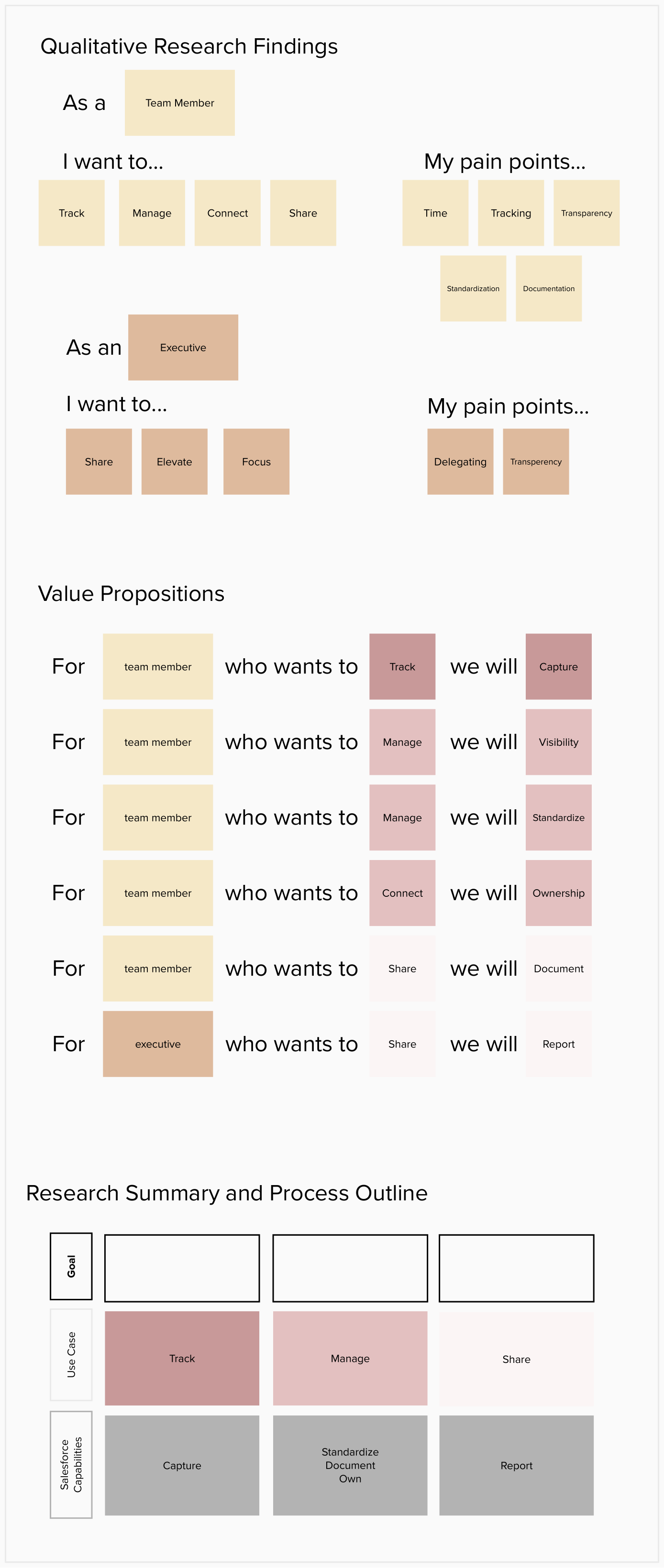
We conducted qualitative interviews with team members to surface their current workflow for documenting project and program progress in order to determine what was working well and what were opportunities for standardization and process improvement. We also took a deep dive into program documentation to explore types of information that was currently documented, what the steps were for processing and approving new requests, the review structure required, and the relevant documented sign-offs for each program. Leveraging our research, we developed a series of value propositions to surface assumptions, expectations, and business value for each user group. We also developed a program concept that captured key phases, handoffs, and use cases in order to determine appropriate Salesforce capabilities to leverage in order to support work taking place in each phase.
Beginning with one program and expanding to two, we developed a process map to model the process for ingestion, qualification, and program execution in order to surface the optimal strategy to document program data in a central Salesforce location. In addition to this, we mapped all current state data attributes stored across platforms into an organized hierarchy and taxonomy.
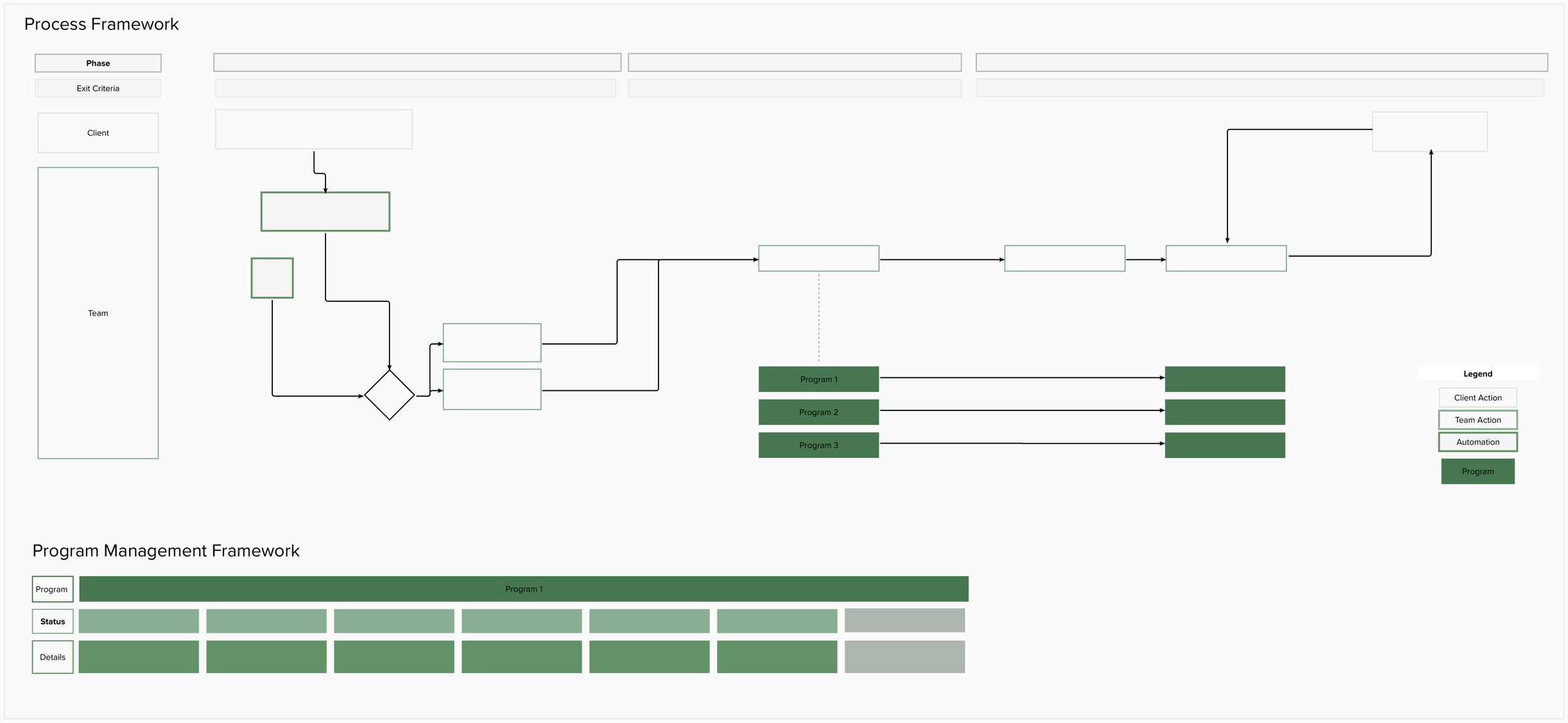
Process Framework
We then leveraged the process map to design automation for intake, approvals, and ongoing management of new applications. Across all three programs, we ensured taxonomy alignment and collaborative capabilities across team members. We iterated on these concepts and prototypes and incorporated team feedback to reflect current state requirements and aspirational future state experience. We tested our assumptions with team members to ensure that the attributes, data structure, and overall taxonomy aligned with program management needs and approach. Lastly, we developed a prioritized backlog for Salesforce development that delivered immediate business value and accounted for future needs.
When: 2022
Creating a Framework and Launching Communities of Practice
We developed the tools and supporting material needed for organizers of future communities of practice to launch successful and sustainable communities. We developed a guide including key areas of strategy development, decision-making, and operations -- each area with detailed question prompts and a workspace for organizers to leverage to launch a new Community of Practice, collaboratively.
The Client
A large, global coffee retailer and distributor
Results that Matter
A team responsible for professional development and continuous improvement wanted to develop the tools and supporting material needed for organizers of future communities of practice to launch successful and sustainable communities.
We developed a guided Miro board organized into key areas of strategy development, decision-making, and operations -- each area with detailed question prompts and a workspace for organizers to leverage to launch a new Community of Practice, collaboratively.
We also delivered an organizer toolkit that covered detailed guides, prompts, and guidance for cultivating a healthy, sustainable, and valuable community.
These artifacts were based on qualitative research and analysis which highlighted the insights, lessons learned, and best practices from organizers of successful communities of practices, as well as communities that had fizzled out or shut down.
How We Did It
We conducted qualitative research with those who had previously launched communities of practice. We then analyzed our findings to surface the key decisions for launching new, sustainable communities of practice. Using our research, we developed a guided Miro board for aspiring organizers to leverage to launch a new community of practice. We designed and delivered a toolkit via Word document and SharePoint page for all organizers of communities of practice.
When: 2022

Process, Causal Loop, and Journey Map Design for Project Management Growth and Scalability
To better understand how project managers might catalyze team success, we delivered a journey map detailing the project manager's experience from onboarding to mastery, a streamlined process map highlighting handoffs throughout a project lifecycle, and a causal loop diagram illustrating the influence a project manager's mastery has on dimensions of business value.
The Client
A technology-focused consulting firm
Results that Matter
This team wanted to better understand the project manager's experience throughout a project lifecycle and how project managers might catalyze team success.
We delivered a data-driven journey map that illustrates the phases of onboarding, managing projects, and mastery which includes relevant experience markers project managers might achieve along their journey toward becoming more mature in their role.
Journey Map
We developed a concept to align four distinct process flows into one interconnected cross-team process model that illustrates the journey from sales to project sustainment in order to highlight handoffs and to identify the role project managers play across the project lifecycle. This process model illustrates where in the lifecycle existing templates may be used and opens conversations about opportunities for further refinement.
Process Map
Causal Loop Diagram
We also delivered a Causal Loop Diagram that illustrates the influence project manager mastery has on dimensions of business value. The diagram describes the relationships between measures of business performance in order to help the team identify the most appropriate ones to measure the success of their work.
How We Did It
We conducted qualitative research with stakeholders to better understand the current project manager experience, what is working well, and what opportunities there may be for growth and improvement. We took a deep dive into annual company objectives, the role project managers play in catalyzing team success, current processes, and other supporting documentation systems that allowed us to determine areas where further alignment could be made. The goal was to understand how the role of project managers could facilitate team alignment and enable success throughout the lifecycle of a project, and how to support project managers when growing in their role. Leveraging qualitative research, we surfaced early insights, distilled and categorized key quotes, and assessed existing processes and templates to identify key areas where project managers could facilitate an even bigger impact. We iterated on these concepts and prototypes and incorporated feedback from project managers and stakeholders to reflect as-is and aspirational experiences. We delivered a journey map detailing the project manager's experience from onboarding to managing projects to mastery, a streamlined process map highlighting handoffs and a project manager's role throughout a project lifecycle, and a causal loop diagram illustrating the influence a project manager's mastery has on dimensions of business value.
When: 2021

Process Design for Global Cross-Sector Coalition for Climate Change
A cross-sector, coalition for climate change needed a better way to collaboratively develop strategy, data-sharing, and tracking towards measurable progress for coalition members towards their climate change goals. We designed and delivered comprehensive process models and process maps that enabled high-quality, strategic decision-making — all ready for scale.
The Client
A cross-sector, co-founded global initiative for climate change
Results that Matter
A global team needed a better way to collaboratively develop strategy, data-sharing, and tracking towards measurable progress for coalition members towards their climate change goals. We delivered a process design that enabled an engineering team to prioritize their work and effectively enable Salesforce as a way of aligning multiple individual and organizational goals and pathways. We surfaced key value proposition statements for each stakeholder in the process and ensured their unique needs were represented in an efficient, clear, and easy to engage in organizational and technical process.
How We Did It
We conducted qualitative research with stakeholders to better understand the human experiences at the center of the processes we would design and optimize. This ensured that our trade-off decisions, process optimizations, taxonomy, and technical information design would best serve the individuals who would participate in the process, across organizational, geographic, and company boundaries. We defined a common taxonomy for the multiple stages, statuses, next steps, and activities that coalition members would travel through as part of their mission as well as touchpoints and events that the coalition organizing team would take. We designed and delivered comprehensive process models and process maps that enabled high-quality, strategic decision-making — all ready for scale.

Process, Reporting, & Dashboard Design for Emergency Response to Covid-19
One of the largest healthcare companies in the US urgently needed a new process and dashboard for tracking the exposure, status, and impact of COVID-19 on essential healthcare workers. We delivered a process design that aligned the data collection, organized the data into a single source, and designed and delivered a single dashboard for all relevant stakeholders to access.
The Client
One of the largest healthcare companies in the US
Results that Matter
A team responsible for tracking the exposure, status, and impact of COVID-19 on essential healthcare workers was building a new tool to receive and track caregiver information. This team wanted to be able to know who was exposed, who should be on furlough, and comply with regulatory guidelines and restrictions that varied from county to county. This team needed the ability to make confident decisions in rapidly changing conditions and have regional level insight into data and trends. We delivered a process design that aligned the data collection, organized the data into a single source, and designed and delivered a single dashboard for all relevant stakeholders to access. The process and data collection redesign delivered a consolidation of forms to minimize call time and reduce irrelevant data collection. The new process also provided clear sorting criteria to direct call center agents and leveraged a single call center portal for easy access. Dashboard insights included call center volumes, performance, areas of need, and searchable records.
How We Did It
We focused on creating a great experience for frontline staff and empowering managers with the information they needed. We conducted qualitative research with staff and managers to discover their questions, points of confusion, and messaging to understand the potential risks for this new process. We tested our ideas early in tight collaboration with our sponsor team. We prototyped in PowerApps and rapidly iterated the solution based on usage and experience. Typical deployment lifecycles were a matter of hours, given the urgency for this solution we launched quickly and refined rapidly to incorporate user feedback.
When: 2020

Process Design to Increase Team and Organizational Performance
For a highly matrixed marketing technology organization, the challenge for this mature team was to design a process for work intake, triage, prioritization, issue management, and stakeholder engagement all balanced with the right cadence, audience, and level of detail. After user testing and making refinements, we launched the new process in a new tool as well as provided supporting documentation and training content.
The Client
One of the largest, global software companies in the world
Results that Matter
For a highly matrixed marketing technology organization, the challenge for this mature team was to design a process for work intake, triage, prioritization, and stakeholder engagement all balanced with the right cadence, audience, and level of detail. We helped the team identify the most critical pieces and activities needed at each phase of the process in order to have as light-touch of a process as possible while delivering the insight, traceability, dependency management, and reporting needed.
How We Did It
We conducted qualitative interviews with business partners, engineers, vendors, and leaders to better understand who participated in this process and what goals and pain points they held. The goal was to understand pain points in the existing process and tools and to surface anything that was working well already to ensure we preserved that great experience. We created process diagrams, user story documentation, principle and use cases for issue management, team meeting agendas for triage and prioritization, and we quickly prototyped the new process in order to user test with a broad audience. After user testing and making refinements, we launched the new process in a new tool as well as provided supporting documentation and training content.
When: 2019

Design a Custom Learning Journey
A team responsible for the professional development of the technology organization wanted to create a cohort-based, experiential learning journey to build a culture of innovation, design thinking, and agility. The learning journey focused on the practices, principles, and mindset that we believed would best deliver a culture of innovation with a focus on human experience.
The Client
A large, global coffee retailer and distributor
Results that Matter
A team responsible for the professional development of the technology organization wanted to create a cohort-based, experiential learning journey to build a culture of innovation, design thinking, and agility. The learning journey focused on the practices, principles, and mindset that we believed would best deliver a culture of innovation with a focus on human experience. We delivered the proposed sequence, learning objectives, and descriptions for each session. We defined guidelines for the practicum project, coaching support, and delivery management.
How We Did It
We conducted qualitative interviews to understand what the envisioned benefits would be for an investment in this learning journey. From culture change to skill building, we considered the diversity of perspective from stakeholders across the organization and multiple levels of management as we entered into a collaborative design session. We explored how we might best deliver on the aspirations within the constraints. Covering the wall with sticky-notes, as we often do, we explored components of great learning experiences and transformations, the relationship between personal change, team change, and organizational change, and the metrics we might use to know whether this learning journey was delivering on its intended mission. We tested our ideas early in tight collaboration with our sponsor team and incorporated their feedback along the way.
When: 2018

Design, Activate, & Facilitate a Community of Change Agents
Connected leaders from multiple social service organizations across the Pacific Northwest to create an aligned vision and mission around the change they wanted to introduce. Together we identified shared measures of success and ways to recognize incremental progress in organizational change.
The Client
A small nonprofit
Results that Matter
Connected leaders from multiple social service organizations across the Pacific Northwest to create an aligned vision and mission around the change they wanted to introduce. Together we identified shared measures of success and ways to recognize incremental progress in organizational change.
Leaders from several different organizations gained design-thinking skills and a first-hand experience in a collaborative design process. We produced and iterated on actionable prototypes to drive organizational change. By testing prototypes, participants gathered meaningful insight and quickly made improvements. Leaders reported that the experience in this ongoing community has increased their ability to test small interventions and share strategies to scale what works.
The convening model built inspiration and accountability to lead organizational change. Participants strengthened their ability to collectively address large-scale social issues by developing strong relationships and networks. At least one agency has plans to scale design-thinking practices throughout their organization.
How We Did It
With any big, intractable problem, it can be easy to feel overwhelmed by the complexity of the causes and constraints. Instead of focusing on what’s not working, we created the time and space to find out what is working well and build more of it. We used qualitative research to uncover small wins, nuances, and practices that were yielding surprising results.
We facilitated collaborative work sessions with stakeholders to analyze the qualitative data and "think big" about ways to create change. Based on our findings, organizations overwhelmingly wanted to connect with each other over a longer period of time.
In collaboration with our nonprofit client, we created a structure that included an in-person kick off meeting, virtual convenings, and peer-to-peer connection calls. In each convening we prepared prototypes (such as new client experience survey, sample job description, or an outline of a new curriculum) to contribute to the organizational transformation each participating organization aspires to achieve. Communicating visually and sourcing feedback from the group surfaced hidden assumptions and brought clarity to the tools and ideas.
Organizations connected as a cohort during an iterative design process which increased leaders' likelihood to collaborate and share strategies for change.
When: 2018

Assessing Board Performance
We illuminated untapped opportunities to accelerate Board Members' professional development and enhance team performance. Making informed, high quality decisions as a Board of Directors means building a practice of surfacing hidden assumptions, challenging biases, and getting closer to the data to understand what’s really happening.
The Client
A medium co-op retailer
Results that Matter
We illuminated untapped opportunities to accelerate Board Members' professional development and enhance team performance.
Making informed, high quality decisions as a Board of Directors means building a practice of surfacing hidden assumptions, challenging biases, and getting closer to the data to understand what’s really happening.
Our assessment helped Trustees more clearly understand their current state, create an optimistic vision for their future, and work together to build high quality strategies that better serve the mission and vision of their organization.
How We Did It
We started by interviewing Board Members to listen for hidden assumptions and beliefs that show up in meetings, daily work, programs, systems, and services. We surfaced shared goals and key opportunities for improvement.
We synthesized what we heard and articulated our findings in the form of themes and trends, prioritized by magnitude of opportunity and potential risk to the Board and the business. We invited board members into a collaborative design process to explore what's possible and to inspire the continuation of research and design.
We created a systems diagram to demonstrate which small investments would have the biggest impact with the lowest cost. We identified leading indicators of success that contribute to the long-term outcomes the Board hopes to create.
When: 2018

Curriculum Redesign
We redesigned a successful training curriculum focused on increasing the maturity of applied soft skills, self-efficacy, and communication skills. Redesigning, updating, and restructuring this curriculum enables outside businesses and government agencies to use the program independently in a flexible, modular way.
The Client
A small nonprofit
Results that Matter
We redesigned a successful training curriculum focused on increasing the maturity of applied soft skills, self-efficacy, and communication skills. Redesigning, updating, and restructuring this curriculum enables outside businesses and government agencies to use the program independently in a flexible, modular way.
Front line employees and managers improved their collaboration and trust by teaching the curriculum. Employees report feeling closer to each other at work and asked for more time for training. Managers report that employees are more engaged and attrition is down. At least one agency has plans deliver the curriculum to all new hires.
How We Did It
We started by interviewing our client collaborators to understand bright spots, challenges, and goals for future delivery. Together we articulated and integrated organizational values and perspectives throughout the curriculum.
Our client wanted to give partner agencies flexibility to cover the most relevant topics in the time they had available. We reformatted the curriculum to make it modular and customizable by each organization. We redesigned the curriculum voice for internal facilitators and took into account organizational policies and legal requirements when switching to a new audience.
We added content and scripted instructions so facilitators could clearly communicate and lead all activities with ease.
When: 2018

Designing A New Approach to Measure Sentiment
For a mature engineering company like our client, measuring technical product performance - availability, response time, scalability - is a part of every-day operations. Instead, the challenge for them was to get a better grip on what really matters most about a product, that is, what lives in the hearts and minds of the people who use it.
The Client
One of the largest, global software companies in the world
Results that Matter
For a mature engineering company like our client, measuring technical product performance - availability, response time, scalability - is a part of every-day operations. Instead, the challenge for them was to get a better grip on what really matters most about a product, that is, what lives in the hearts and minds of the people who use it. Navicet helped them understand the nuances of how people experienced their product today with a baseline of user perception. This index can be used to measure progress and prioritize the work that really matters to deliver a world-class service experience.
How We Did It
We talked the team to learn about their goals, and then interviewed users to see how their experiences stacked up. We used those interviews to develop a collection of focused questions, taxonomy of emotion, and an algorithm to produce an index of user sentiment. We organized it all into a survey and tested it out with some users.
Finally, we designed visualizations that allowed stakeholders to determine at a glance how the product was performing, set targets, focus on key risk areas, and agree the best course of action to deliver the best possible experiences.
When: 2017

Design End-to-End Customer Experience Services
The challenge was to strengthen customer brand advocacy and loyalty by measuring and optimizing end-to-end customer experience. We built a Customer Experience strategy, defined a service model to serve IT project teams, and developed a communication plan for business leaders, executives, and technology Architects.
The client
A large telecommunications company
Results that matter
The challenge was to strengthen customer brand advocacy and loyalty by measuring and optimizing end-to-end customer experience. We built a Customer Experience strategy, defined a service model to serve IT project teams, and developed a communication plan for business leaders, executives, and technology Architects.
How we did it
In partnership with the Enterprise Architecture team, we facilitated collaborative design sessions with our sponsor to build a strategy, service definitions, and a compelling narrative to sell the mission and services internally. We plastered the walls with sketches, prototypes, sticky-notes, and the desired experience arch that we wanted our audience to have when our sponsor pitched the services to internal stakeholders, beneficiaries, and consumers. We tested the services early, incorporating feedback and listening carefully to the audience's perception of value in each service. In tight collaboration with our sponsor, we worked alongside one another to iterate and refine daily until the services were clearly defined and the leadership presentation crisp, concise, and emotionally engaging.
When: 2016

Launch an Innovation Lab for Social Services
In collaboration with the Executive Director and key team leads, we created an innovation lab to design processes, products, and other pragmatic interventions for other nonprofits and government agencies.
The client
A small nonprofit
Results that matter
In collaboration with the Executive Director and key team leads, we created an innovation lab to design processes, products, and other pragmatic interventions for other nonprofits and government agencies.
How we did it
When we say we build design-driven organizations, this is what we are talking about. We started by teaching basic design practices, like brainstorming, prototyping, research, and user testing. We picked a couple small projects and helped them apply what they learned. We sketched out the methodology and helped them plan more projects using what they learned. We took the time to help them get comfortable with ambiguity, iteration, and refinement. Eventually, the training wheels came off and the team uses design practices to create unexpected value for their clients.
When: 2016
Persona Development
For a large coffee company, we created personas that inspired empathy and the creation of innovative new services. Project teams and leaders use these personas to prioritize investments and measure business impact on an ongoing basis.
The client
A large, global coffee retailer and distributor
Results that matter
We created personas that inspired empathy and the creation of innovative new services. Project teams and leaders use these personas to prioritize investments and measure business impact on an ongoing basis.
How we did it
The Strategic Technology Practices team invited us to build a user model of the clients they serve. We interviewed over 25 representatives across IT, transcribed those interviews and printed each comment on a card, and then held several collaborative sessions to synthesize, distill, and organize the results from the interviews into themes and insights. We used those themes and insights to build personas that reflect the core population of the technology employees. These personas were used by project teams and leaders alike to guide their investments so that they have the maximum positive impact.
When: 2015 - 2016

Design for Business Value Training (ongoing)
If you ever wondered how to generate more focused creativity and innovation in a corporate environment, this class is for you. After two days, participants leave this class with practical experiences, insights, and pragmatic tools to apply the practice of collaborative design into their day-to-day work.
The client(s)
Large software company, global coffee company, medium consulting company, small nonprofit, and sessions available to the general public
Results that matter
If you ever wondered how to generate more focused creativity and innovation in a corporate environment, this class is for you. After two days, participants leave this class with practical experiences, insights, and pragmatic tools to apply the practice of collaborative design into their day-to-day work.
How we did (and currently do) it
This two-day, hands-on, team-oriented workshop is for technology project participants and business stakeholders who want to learn how to use design practices to improve the impact of their work. This course is highly interactive. No prior design or technical experience is necessary, just a willingness to show up and try something new.
Participants learn key principles of user-centered design and apply them to an example project over two days. Graduates gain a better understanding of how to measure project success and how to translate what they learned in class into the real world.
Here’s the full agenda:
Foundations
- Design principles and the case for design
- Linking strategy to execution
Insight
- Measuring business value - metrics
- Assessing capabilities
- User research
- Building personas
- Measuring success- quality in use
- Creating scenarios
- Measuring scenarios through user experience outcomes
- Requirements, business process, and user stories
- Value-driven prioritization
Innovation
- Brainstorming
- Sketching and storyboarding
- Building prototypes
- Early user testing
Implications
- A new way to work - why design matters
- Sustaining the change - team journey map
- 5 working principles
When: 2014 - Present

Metrics Design for Business Results Training (ongoing)
Approached by one of our favorite clients, we were tasked with creating a customized training for team managers, Product Managers, Project Managers, and Program Managers to learn how to identify and build an actionable measurement system in order to optimize business performance.
The client(s)
A large, global coffee retailer and distributor
Results that matter
Approached by one of our favorite clients, we were tasked with creating a customized training for team managers, Product Managers, Project Managers, and Program Managers to learn how to identify and build an actionable measurement system in order to optimize business performance.
The first half-day, participants will learn the case for measurement and how to link to strategy to execution using example work. The second, full-day of class, participants begin to apply these lessons to their own work, build a measurement system for their project/product/team, and learn how to select the best data visualizations to communicate value and progress.
The one-and-a-half-day training course is paired with two hours of personalized coaching for each graduate so that they are able to effectively apply what they learn in their day-to-day work.
How we did (and currently do) it
We had been thinking about building a measurement curriculum and training experience for a while, since it’s such an important part of the design process, and thankfully our client nudged us bring it to life. Defining the measures of success is key to getting to success with a new project, product, or initiative. We wanted to create a class that helps managers translate strategy into measurable outcomes so that as teams launch into designing new features, products, enhancements, or processes they have a concrete north star to check their designs and decisions against.
We know that choosing the right measures is rarely obvious and choosing a single, simple measure can be attractive but may also drive the wrong behavior and have unintended consequences. Having a defined set of measures empowers partners to be able to make high-quality, independent, consistent decisions across the team and organization. We also knew that we wanted to tie in data visualization because numbers in rows and columns doesn’t always communicate the full impact of the measures we’re looking at. By visualizing data we’re able to surface the meaningful narrative behind the numbers, and this empowers teams to be able to communicate the impact of those numbers more broadly across different groups and disciplines.
With all of the above in mind, after interviewing our stakeholders we locked ourselves in the office with sticky notes and the big white-board and got to work on building a curriculum. When it got too hard, we quit for a little while, did something else, and picked it back up with fresh brains. We repeated that process until we created something that we all thought was excellent.
When: 2016 - Present

Business Value Workshops (ongoing)
Through a set of structured discussion points designed to surface key assumptions and expectations, participants commit their undivided attention to a discussion that builds a clear vision of business success for a project or program team. At the end, we have a comprehensive sketch of the measures of success, capabilities, key personas, user scenarios, and some representative process requirements.
The client(s)
Large software company, global coffee company, medium consulting company, small nonprofit
Results that matter
Through a set of structured discussion points designed to surface key assumptions and expectations, participants commit their undivided attention to a discussion that builds a clear vision of business success for a project or program team. At the end, we have a comprehensive sketch of the measures of success, capabilities, key personas, user scenarios, and some representative process requirements. After the facilitated discussion, we disappear for a week, analyze what the group came up, apply some additional rigor, and bring back a more mature version for the team. This framework is used to guide higher quality decisions, increase accountability for results, and enhance collaboration among team members.
How we did (and currently do) it
We invite the organization leadership team, initiative leadership team, or the project leadership team to the discussion, depending on the scale and intention of the discussion. In the case of a project team you see business leaders, solution management, business and technical architects, UX leads, and other key engineering leads.
Through a set of structured discussion points designed to surface key assumptions and expectations, participants commit their undivided attention to a discussion that builds a clear vision of business success for a project, program, or organization. No preparation from workshop participants is required. The more prep that happens, the less learning typically happens in the workshop. The intention is to arrive at a common understanding, which inevitably means leaving some passionate beliefs behind and adopting new insights from other participants. It’s best to show up having thought about things a little, but PowerPoint decks and other documents rarely contribute any value to the discussion.
Learn more about the process from our Planning Guide
When: 2014 - Present

Lead Innovation Projects for Social Services
Leading the design process to create interventions that build strength and wellness for families experiencing poverty.
The client
A small nonprofit
Results that matter
Leading the design process to create interventions that build strength and wellness for families experiencing poverty.
How we did it
We helped our client Launch an Innovation Lab and they asked us to stick around to integrate the design process into the nonprofit and smooth the pathway to becoming a design-led company. While we help do the work, we’re coaching and training along the way so that the team is prepared to scale and lead the design process all on their own too. We like to make sure the work we do stays alive, so no tossing this one over the fence and hoping it keeps going – we’re working right alongside them to help overcome any barriers as they design a new way of working to achieve their mission.
When: 2016 - Present

Design and Develop Customer Experience Software (SaaS)
For a consulting company seeking to expand from a leader in their segment to into a software development company, we translated a high-level product vision and corporate strategy into a product launch plan, defined and prioritized features for MLP (minimum lovable product), and built an interactive prototype to test the product concept and communicate the product vision to investors and customers.
The client
A consulting company transitioning from a leader in their segment into a new software product company
Results that matter
Building on their product vision, we created a product launch plan, defined and prioritized features for MLP (minimum lovable product), and built an interactive prototype to test the product concept and communicate the product vision to investors and customers.
How we did it
This product was intended to translate a manual, organic process into a repeatable, scalable process which saves time and money for the consultants and puts their clients in the driver's seat to manage and iterate on the artifacts produced. We started by analyzing all the product vision, mission, and competitive landscape documentation the consulting company put together. After entrenching ourselves in the current state, we launched into exploring "how might we." We dove into collaborative design sessions which included the business sponsor from the consulting company, the developers from the technical side, our designer, our product manager, and our superstar design facilitator (that's Peter). We iterated fast - oftentimes producing fully interactive prototypes daily to illustrate several design paths we might follow. In tight collaboration with the business sponsor and developers, we produced a prioritized list of features and a product launch plan. The consulting business sponsor used the interactive prototype to communicate the vision to investors and customers.